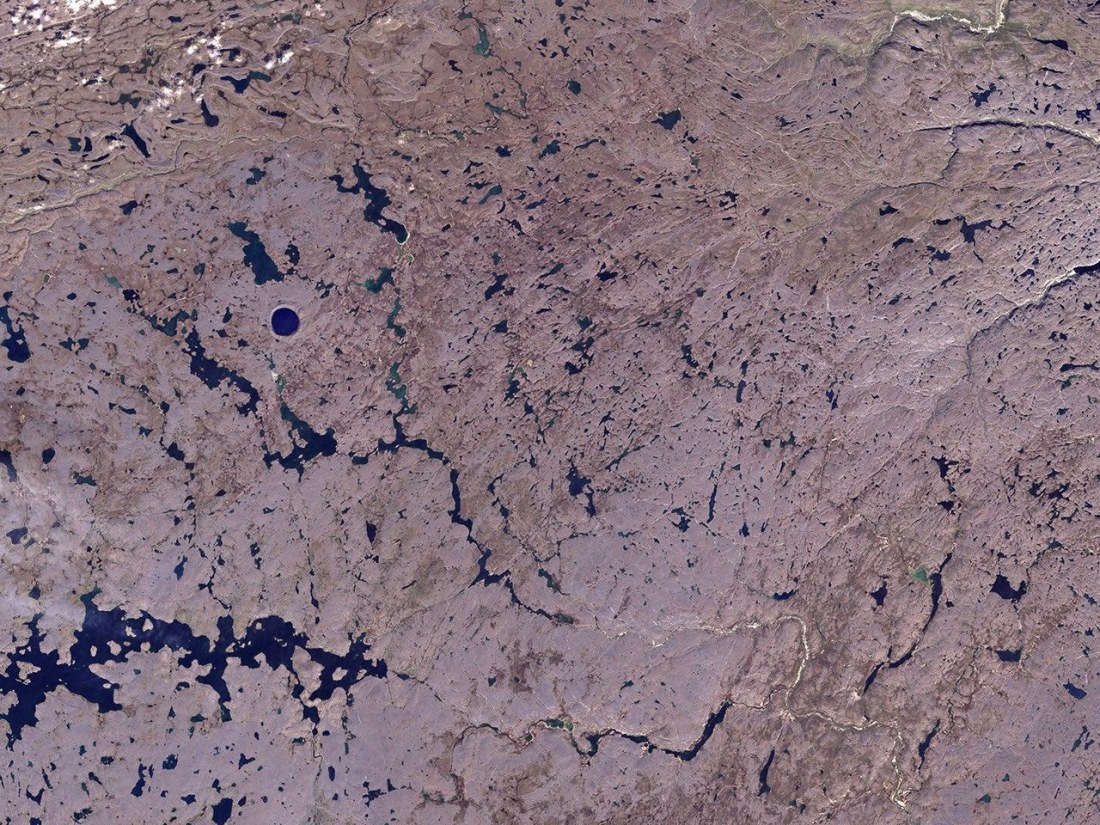
Pingualuit in northern Quebec: a 3.44 km circle holding a lake 267 m deep, with no inlet and no outlet. Image: NASA Earth Observatory, Landsat 7.
A crater lake is a closed basin, and that is its scientific value: nothing flows in or out, so sediment accumulates undisturbed and records climate, vegetation and fallout layer by layer. These five are impact craters that hold water today, ordered from the largest ring of water to the smallest.
-
Manicouagan, Quebec — a ring 70 km across. The best-known crater lake on Earth is not quite a lake in a crater: the annular Manicouagan Reservoir fills the ring between the inner island and the outer rim, a shape produced by damming the Manicouagan River in 1968. The ring of water is about 70 km across and traces the crater floor. The impact was 214 million years ago; the shoreline has been a reservoir for less than sixty.
-
Elgygytgyn, Russia — 18 km, 3.5 million years. A crater lake in Chukotka, north of the Arctic Circle, that the ice sheets never reached. Its 3.5-million-year sediment record is the longest continuous Arctic climate archive, and it was drilled in 2009 for exactly that reason. The lake is about 170 m deep and stays frozen for most of the year.
-
Lake Bosumtwi, Ghana — 10.5 km crater, 1.07 million years. The crater is about 10.5 km across, and the lake fills its inner basin, about 8 km wide. The rim rises several hundred metres above the surrounding forest. Glassy tektites found in Ivory Coast match the crater in age and chemistry, which is how the impact was tied to them. The lake is sacred in Ashanti tradition, and fishing on it is restricted.
-
Pingualuit, Quebec — 3.44 km, 267 m deep. A near-perfect circle in the Ungava tundra, formed about 1.4 million years ago. The lake has no inlet and no outlet, and its sediments escaped the scouring that glaciers gave every other lake in the region, so cores from the bottom record interglacial periods the surrounding land has forgotten.
-
Lonar, India — 1.83 km, age unsettled. A young crater in the Deccan basalt, and the only known impact crater formed entirely in basaltic rock on Earth. The lake is both saline and alkaline, and the rim still closes completely. Its age is the one thing about it that will not settle: thermoluminescence on the impact glass gives 52,000 ± 6,000 years, cosmogenic exposure dating of the rim gives about 37,500, and argon-argon dating of the melt rock gave 570,000 ± 47,000, which other workers attribute to inherited argon in the samples. Because the target was lava rather than sediment, the shocked rock at Lonar looks different from most impact sites, and early geologists argued that it was volcanic.
None of these is a simple bowl of water in a hole: Manicouagan's crater holds a reservoir, Bosumtwi's is a cultural site and Elgygytgyn's is a climate archive. All five share a rim that closes the basin, and that closure is what makes the sediment record readable.