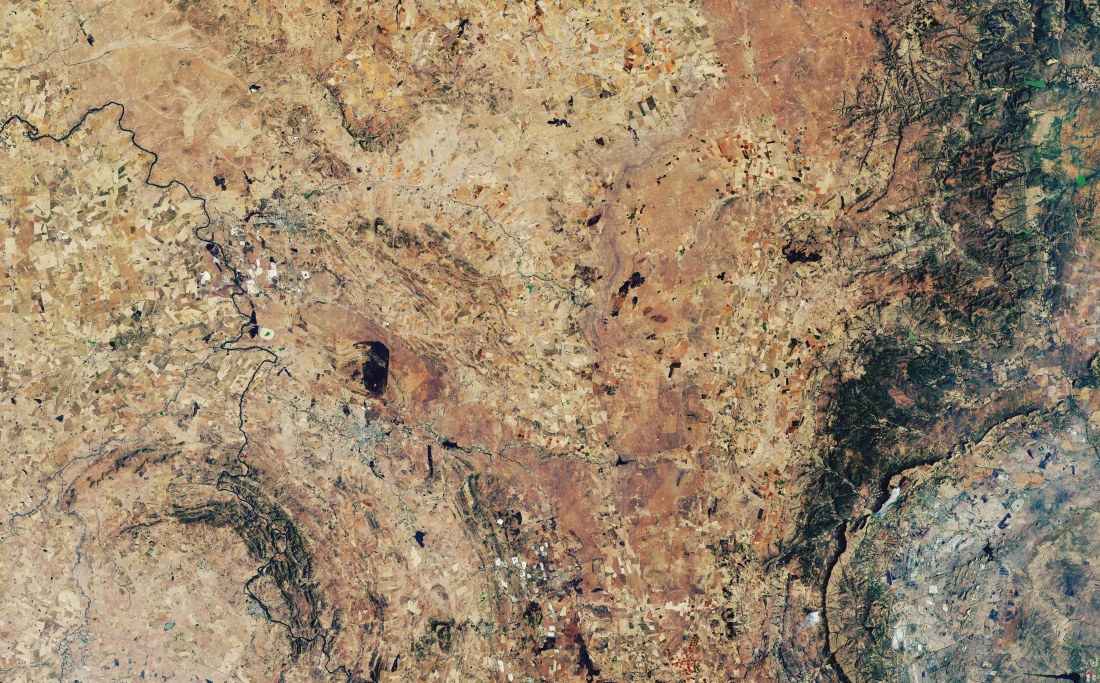
The Vredefort structure in false colour: the crescent of the dome is the surviving root of the impact, the rest of the original ring long since eroded. The Vaal River crosses it. Image: NASA Earth Observatory, Landsat 8.
About 190 impact structures have been confirmed on Earth, and the largest ones are not the ones with the cleanest outlines: three of the five below are buried, deformed or eroded past recognition as craters. Sizes are quoted as the original rim diameter, which for structures this old is an estimate read from the surviving rings, so ranges are normal. The figures come from the Earth Impact Database, which has been offline since 2020, and from the surveys that have replaced it: the 2021 compilation of the crater record by Kenkmann, and the age list of Schmieder and Kring. Where the sources disagree the range is given rather than a single number.
-
Vredefort, South Africa — about 275 km originally. The oldest and largest confirmed impact structure on Earth, formed 2.023 billion years ago. The Earth Impact Database lists the preserved structure at 160 km; the 2021 compilation puts the original rim at 275 km, and Schmieder and Kring put it at 250 to 300 km, probably as a multiring basin. Two billion years of erosion has cut the bowl down to its roots. What survives is the Vredefort Dome, a 40 to 50 km crescent of uplifted rock where the crust rebounded after the impact, now a World Heritage Site. The Vaal River cuts through it.
-
Sudbury, Canada — at least 200 km originally. A 1.85-billion-year-old structure, now a basin 62 km long and 30 km wide. The original crater is thought to have been at least 200 km across before deformation and erosion shortened it. The impact melted a sheet of crust that cooled as the Sudbury Igneous Complex, and the nickel and copper ores mined around its rim have been worked since the 1880s — the mines were there for a century before the basin was accepted as an impact structure.
-
Chicxulub, Mexico — 150 km in the database, nearer 200 km by later work. The crater that ended the Cretaceous is buried under 300 to 1,000 m of limestone on the Yucatán shelf and has never been seen at the surface. Gravity surveys in the late 1970s found the ring; drilling and ejecta layers confirmed it. The database figure of 150 km is the diameter of the mapped ring; seismic and gravity modelling since puts the original transient crater nearer 200 km, which is why its rank here is arguable. Its age, 66 million years, matches the Cretaceous–Paleogene boundary to within a few tens of thousands of years.
-
Popigai, Russia — about 100 km. A 35.7-million-year-old crater in northern Siberia and the best preserved of the five: erosion has barely touched it. NASA describes it as nearly 100 km across, the fourth largest verified crater, tied with Manicouagan; some catalogues give 90 km. Its target rock was graphite-bearing, and the impact turned some of it into diamond.
-
Manicouagan, Canada — about 100 km. A 214-million-year-old structure in Quebec, eroded to a ring of hills around a lake. The annular Manicouagan Reservoir follows the crater rim, and the island inside it, René-Levasseur, is one of the largest lake islands in the world. The Earth Impact Database lists 85 km for the preserved structure; the original crater is put at about 100 km.
Two of the five are known mainly from the rock record rather than from any circular feature on a map, and one, Chicxulub, is known mainly from what it threw out. The largest impacts are the hardest to see, and the sizes quoted for them change when the rings are re-mapped. The list ranks the largest confirmed structures, not the largest that ever hit: a crater wider than Vredefort could sit under a continental shelf or an ice sheet and not have been found.