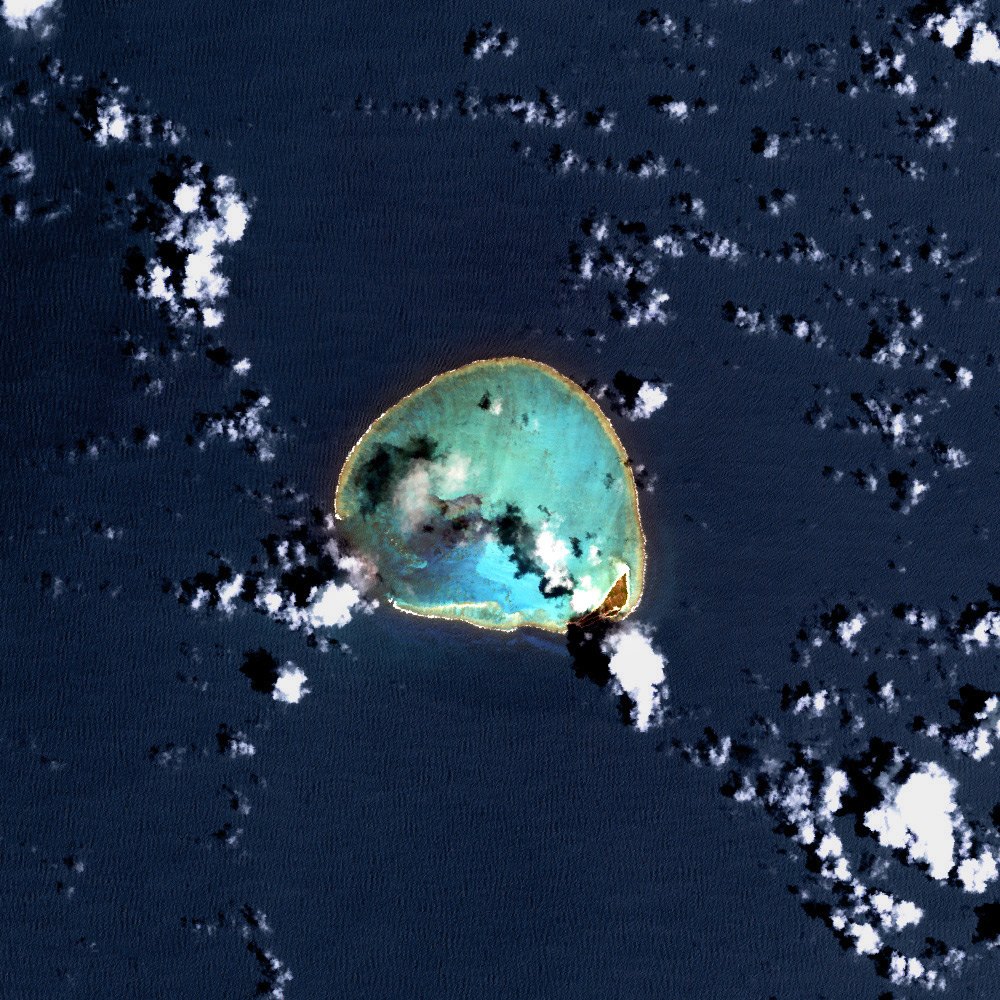
Kure Atoll in the north-western Hawaiian Islands. An atoll is a rim of coral limestone around a drowned volcano; most of its area, and nearly all of its structure, is under water. Image: NOAA.
An atoll is a ring of coral limestone around a lagoon, built on the drowned summit of a volcano. Almost all of it lies under water — rim, lagoon and drowned slope — which is why the largest ones are invisible from the surface, and why their sizes are argued over: count the lagoon and the rim, or the rim only, and the ranking changes. The five below follow the 2023 global census by the Millennium Coral Reef Mapping Project, which mapped 598 atolls from Landsat imagery on one consistent method (Andréfouët and Paul, Marine Pollution Bulletin 194, 115400). The older table still widely copied — the 2001 Geological Society of America compilation of 301 atolls, from Purdy and Winterer — gives different numbers and a slightly different order, noted below where it differs.
-
Great Chagos Bank — 12,811 km² (2001 table: 12,642). The largest atoll structure on Earth, in the Chagos Archipelago about 500 km south of the Maldives. Almost all of it is submerged: eight low sandy islands break the surface, with a combined land area of about 5.6 km². The bank has been a strict nature reserve since 1998, and its reefs are among the least disturbed in the Indian Ocean for the simple reason that nobody lives there. Figures near 13,500 km² in some accounts take in the drowned slopes beyond the rim.
-
Bellona, New Caledonia — 8,897 km². A drowned atoll in the Coral Sea, about 60 km south of the Chesterfield Islands and nearly 500 km from Grande Terre. Only two cays break the surface, the Observatory cay and the east cay, and neither is inhabited; everything else is rim and lagoon under water, which is why the atoll stayed almost unmapped until satellite imagery arrived. The whole plateau has been a full reserve since 1 January 2024.
-
Reed Bank complex, Spratly Islands — 7,813 km², listed as Liyue Antang Bank (2001 table: 8,866 for Reed Bank). A submerged atoll west of Palawan with no emergent land at all. Its shallowest ground lies between about 9 and 16 m down depending on the survey, shallow enough for vigorous coral growth and, at its edges, for the drop-offs that make it a dive site. It sits in disputed water and survey work has been intermittent for decades. Some atoll catalogues exclude it as a mostly drowned bank rather than an atoll.
-
Macclesfield Bank, South China Sea — 5,828 km², listed as Zhongsha (2001 table: 6,448). An elongated submerged atoll about 130 km long and 70 km wide, east of the Paracel Islands. Its broken rim lies 11.8 to 18 m below the surface and there is no dry land anywhere on it; nineteenth-century navigators knew it chiefly as a hazard that made the sea high and confused in heavy weather. The lagoon is shallow and fills with sediment, which makes the coral community unusual for a structure of that size.
-
Chesterfield Atoll, New Caledonia — 4,118 km². A Coral Sea atoll 550 km north-west of Grande Terre, made up of eleven uninhabited islets around a lagoon of roughly 3,500 km². It is the largest atoll in French territory and, with Bellona next door, part of the Natural Park of the Coral Sea. The islets carry seabird colonies of regional importance, which is the main reason the plateau is protected rather than exploited.
Area alone produces an unusual list: two of the top five have no dry land at all. The largest atoll with inhabited islands, Thiladhunmathi-Miladhunmadulu in the Maldives, comes sixth at 3,787 km², with Huvadhu seventh at 3,280 km²; Kwajalein, at 2,458 km², is the largest whose rim is fully emergent. The ranking also depends on what counts as an atoll: Goldberg's 2016 catalogue excludes Reed Bank and Macclesfield as mostly submerged banks, which would drop two entries here and promote the two Maldivian atolls into the top five. If land rather than area is what matters, Kiritimati in Kiribati has the most dry ground of any atoll, about 388 km². What the five share is that almost all of their area is submerged: only a few metres of limestone and coral stand above sea level.