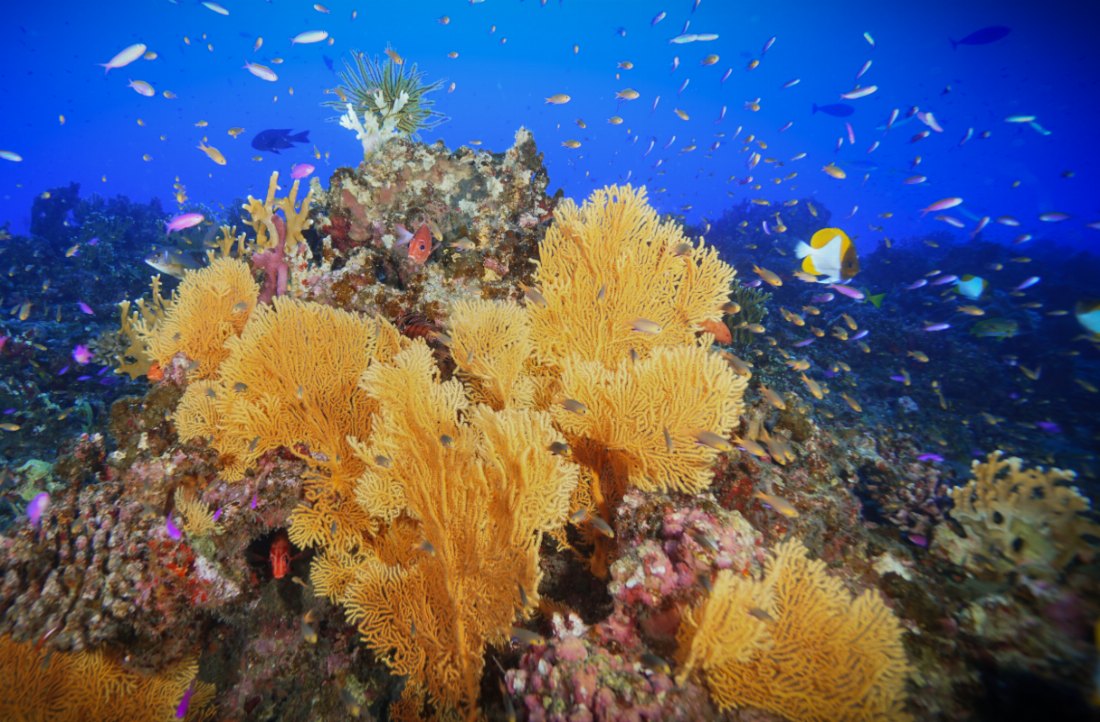
Sea fans and reef fish on a Pacific slope. The most species-rich reefs are not the largest ones — they are the ones with the longest, warmest and most connected history. Image: NOAA.
Counting coral species is harder than it sounds: the totals depend on how much of a reef has been surveyed, how the taxonomists split the genera, and whether soft corals are counted with the hard ones. The five below are ranked by the number of hard coral species recorded, with the survey basis given for each. They sit in the Indo-Pacific, and the reason is geological: the Coral Triangle has been a shallow, warm, connected sea for millions of years, and it has the highest reef diversity on Earth.
-
Raja Ampat, Indonesia — 553 species. The most coral species recorded in any area of its size, and about 75 per cent of all known hard corals. Surveys there have reported 537, 553 and 574 species at different times, the difference being new records and revised taxonomy rather than change in the water. The archipelago also holds more than 1,600 species of reef fish, and it sits at the eastern edge of the Coral Triangle, where Pacific and Indian Ocean faunas overlap.
-
New Caledonia — 510 species. The World Atlas of Coral Reefs (2001) records 510 coral species in the New Caledonian lagoons, which is why UNESCO describes the system as equal to or richer than the Great Barrier Reef in coral diversity. Its isolation has also produced endemism: a share of its species and a larger share of its molluscs are found nowhere else.
-
Great Barrier Reef — 450 species of hard coral. The Australian reef has fewer species than the two above, and vastly more of them: 450 hard corals plus at least 1,000 species of soft coral and sea pens. It is the best-surveyed reef system in the world, which cuts both ways — the count is more complete than most, so it is also more directly comparable.
-
The Coral Triangle as a region — 76 per cent of the world's coral species. The six-country region covering Indonesia, Malaysia, Papua New Guinea, the Philippines, the Solomon Islands and Timor-Leste holds about three-quarters of all reef-building coral species and more than 3,000 species of reef fish. It is the reason the top of this list is Indonesian and not Australian: diversity peaks in the centre of the triangle and falls away with distance from it.
-
The Caribbean — more than 60 reef-building species. The western Atlantic has an order of magnitude fewer corals than the Indo-Pacific, a legacy of the Isthmus of Panama closing about three million years ago and of the region's smaller, more isolated reef area. The Mesoamerican Reef holds more than 60 reef-building species out of a regional total of about 65 — nearly the whole fauna in one system, which is why a single disease outbreak can matter so much there.
The totals are not the whole story. What matters is which species build the structure, how fast they grow and whether one heat event kills all of them. On the Great Barrier Reef a handful of branching corals provide most of the structure, and those are the ones that bleach first. In Raja Ampat many species live in deep or turbid water, where temperatures during a heatwave are lower than at the surface.